Most people use Instagram for selfies and snapshots of their lives. I use it for music.
Every day, I post songs to Instagram, each one paired with an image made with my own creative AI, or sometimes just a single color. The full-length songs go into public YouTube Music playlists, one for each day, linked from deepak108.com. Together they work like a live radio station: a running music diary, a DJ set that changes every day, and a place to discover new songs, with visuals. I call the project Instagram Artifacts.
At a glance
- More than 14,000 posts on @deepakart108, by my own count.
- Music-first since August 30, 2026: new posts most days, each pairing a clip of up to 90 seconds from Instagram’s music library with an image.
- Images from Venaura, the creative AI collaborator I built in ChatGPT and keep refining.
- A dated YouTube Music playlist for every day, with the full songs.
- Every post chosen and published by hand from my phone. Nothing is automated or bulk-posted.
How it started
The practice began in 2025. I was creating AI images, hosting them on YouTube and placing them in my blog posts, where each image illustrated what I’d written. Sometimes I added music. By mid-December 2025 I had posted thousands of times, and then I stepped away to focus on other projects.
On August 30, 2026, I came back with a different focus: music first. The images no longer illustrate blog posts. They exist alongside the songs, and what started as simple song-and-image pairings has grown into a whole system: story sequences, visual trips, color cards, call-and-response between songs, and a profile grid I compose like a canvas.
Meet Venaura, my creative AI
I don’t use a general-purpose image tool. The visuals come from Venaura, a creative collaborator I built in ChatGPT: first as a custom GPT, with full instructions I’ve rewritten dozens of times, and now as a dedicated ChatGPT project for this practice. I didn’t build the underlying image model. What I built is how it works with me.
Venaura runs on a set of written guides I maintain, including:
- a music and image-making style guide;
- operating rules for live Instagram sessions;
- a storytelling protocol for multi-image sequences;
- a “world exploration map” for moving through scenes and places;
- guidelines for how it should collaborate with me, including when to suggest and when to simply create.
It turns my short prompts into complete image briefs, formatted the same way every time. Each brief sets the 4:5 portrait framing, camera angle and lens, lighting, setting, continuity with the previous image, and what to leave out, such as stray text, logos and watermarks. After more than 14,000 images together, it knows me very well. A few words from me become exactly the image I had in mind, which is why the practice is fast and the results beat anything I get from a general model.
One principle guides it: optimize tedious translation, not authorship. The AI takes on the slow work of turning an idea into a detailed prompt. The listening, choosing and improvising stay with me, because that’s the part I enjoy.
How a post gets made
- A spark: a song, a lyric, a memory, a place, an autoplay surprise or the previous post. There’s no fixed starting point.
- The concept: I talk it through with Venaura. It suggests scenes, metaphors or camera angles, and I accept, change or redirect them.
- The prompt: the idea becomes a structured image brief.
- The image: I judge whether it lands, then keep it, revise it or drop the idea.
- The music: I choose the song. Sometimes it inspired the image, sometimes the image came first, and sometimes they just meet.
- Publishing: I post it by hand from my iPhone and choose the clip, order and timing.
- The archive: the post joins the feed, the full song joins that day’s playlist, and old posts become callbacks for new ones.
Sessions run in three modes. In song-led sessions, the music suggests the image. In world-led sessions, I explore a place and find songs to fit. In live collision, the most fun of the three, a song, an image and a new idea all arrive at once and change the direction mid-session.
Taking trips
My favorite part is the trips. A sequence of posts becomes a journey, often 24 songs or more, where each image is the next stop and the music travels with it.
- Through time: an animated trip back to the age of dinosaurs.
- Into space: aboard a spaceship to a distant planet and the aliens who live there, or a tour of black holes, stars and planets.
- Across the world: a road trip across the USA, a flight to China or South Korea, a journey through India or France.
- At speed: a car racing around a track, lap after lap.
The playlist follows the route. A trip to China brings in Mandopop. South Korea brings K-pop. India brings its own range of sounds. France mixes top Western hits with French songs.
Some sequences are quieter, more like frames from a film. A sequence might stay in one room while something changes inside it. Or it might bring an animal into the scene, follow a background character, move from inside to out, or step from an ordinary place into a fantastic one. One recent sequence began in a calm interior and drifted outdoors to the water and an old, familiar boat. I often don’t know where a story is going when I make the first frame. I call it live generative cinema: Venaura keeps the details consistent from frame to frame, and I decide what happens next.
Color cards and the grid
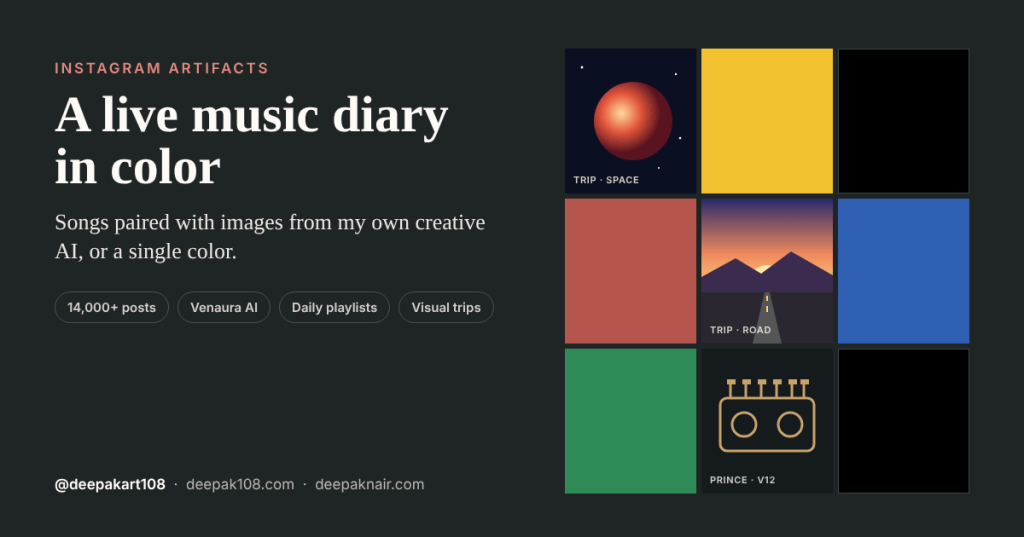
Not every song needs a new picture. Some posts are a single solid color: red, green, blue, yellow, all black. These aren’t placeholders; they’re part of the vocabulary. A color card lets the music take center stage, keeps the practice moving without generating something new every time, and makes the detailed illustrations stand out more by contrast. Knowing when not to generate is part of the craft.
I also compose for Instagram’s three-column grid. Three related images, an alternating color pattern or a deliberate break all read as a second layer of design. You can experience the feed one post at a time, or step back and see the profile as a larger picture.
Music is the engine
I don’t follow a fixed playlist or genre. Pop, rap, rock, alternative, electro-house, K-pop, R&B, jazz and blues all turn up, chosen live by energy, memory, lyrics and whatever connections appear as I listen.
Sometimes the songs talk to each other. Recently The Donnas’ “Tell Me Your Name” was followed by Prince’s “My Name Is Prince”: one asks, the next answers. For Prince, the image was a gleaming V12 engine, matching his charisma and power with the power of a great machine. The connection works without illustrating the lyrics literally, and that kind of logic runs through the whole feed.
I also use Gemini on the music side, for song recommendations and to look back over my daily playlists for patterns in how my mind connects one song to the next.
Three ways to experience it
- Listen and watch: hear each song while the images and colors move with it.
- Watch on silent: if you already have your own music playing, mute the feed and just look. The song titles rotate through the post details, so you can still see what’s playing.
- Play the full set: open the day’s playlist on YouTube Music and let it run like a radio station.
Who decides what
This isn’t an automated content feed or an AI agent posting on its own. Venaura generates possibilities: ideas, prompts, images, continuity and feedback. I make the decisions: the music, the direction, which images are kept or rejected, the sequence and when each post goes out. AI widens what’s possible; my judgment decides what becomes part of the work.
Why I do it
This practice keeps me focused and happy. It steadies my energy and mood through the day. It’s flexible, too. I can run it in the background while I do yoga, chores or my work, or I can give it my full attention as a practice in itself.
It’s also a form of service. Every day, someone might find a song they’ve never heard, or an artist from a country they’ve never listened to, or simply a color that matches how they feel.
It has made me better at my work, too. Running it means designing and maintaining an AI collaborator, writing and refining prompts, judging output quality, keeping a high-volume publishing routine and organizing an archive across platforms. That’s the same AI-assisted content operations work I do professionally, in a setting where I get to follow my curiosity every day.
Come listen
Follow along on Instagram (@deepakart108) for the daily posts, or visit deepak108.com for the full dated playlists on YouTube Music.


Leave a Reply