After a few years of publishing almost daily, my site had a problem that every long-running content library eventually hits: content debt. I had 5,968 published posts, mostly recipes and concept designs, along with spirituality pieces, travel guides, fitness routines, fiction and AI projects. Thousands of them sat in one catch-all category called “Excellent.” Nearly a hundred tags were attached to nothing, and almost none of the posts had a real SEO description.
Fixing that by hand wasn’t realistic. Handing a live site to an AI and hoping for the best wasn’t acceptable either. So I treated it like an operations project, with two AI models in separate roles. Claude, connected to my WordPress.com site through the WordPress.com MCP connector, did the work. Gemini acted as my project manager and reviewer. That meant a written plan, an audit before any changes, my approval at every gate, and checks on every write.
Two Models, Two Jobs
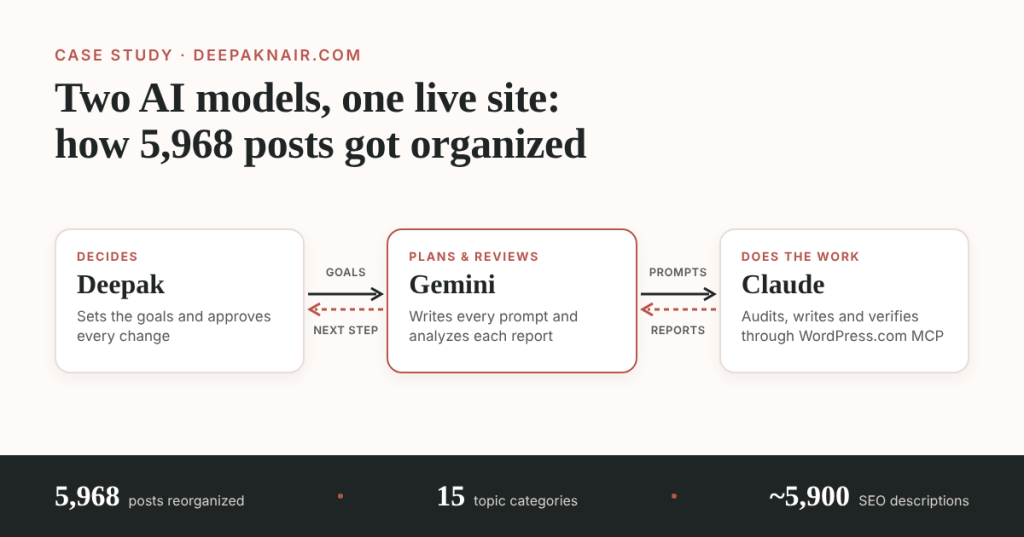
I never wrote a prompt to Claude myself. Instead I worked in a loop:
- I told Gemini what I wanted in plain language: clean up the categories, fix the SEO, don’t break anything.
- Gemini wrote the prompt, and I gave it to Claude.
- Claude did the work and reported back. That meant audits, proposed plans, review lists, batch results and the problems it found.
- Gemini analyzed Claude’s report: what was done, what was flagged, what needed a decision. Then it drafted my next instruction.
- I made the final call before anything was sent.
This split kept each model doing what it was best at. Claude had the live site connection and did the detailed, hands-on work: reading thousands of posts, proposing category rules and move lists, writing descriptions, and verifying every change. Gemini was a second set of eyes outside that context. It turned Claude’s reports into clear decisions and kept the project moving from phase to phase. Every approval to change something on the live site still came from me.
The Results
- 5,968 published posts organized into 15 topic categories, replacing a catch-all category that held most of the archive.
- About 5,900 custom SEO meta descriptions written and saved across posts and pages, plus a site-wide homepage description.
- A read-only audit of 4,443 posts in the two largest categories, which flagged 246 for review.
- Hundreds of approved recategorizations in several passes, including a final sweep of 212 moves.
- 96 unused tags deleted (124 down to 28).
- Nothing overwritten by accident. No existing SEO description was replaced, and no draft was touched.
The Setup
The site runs on WordPress.com’s Premium plan, which includes SEO tools. Claude worked through the WordPress.com MCP connector, which lets it list, read and update posts, pages, categories, tags and site settings through authorized WordPress.com endpoints. It could also read Jetpack traffic stats. There were no CSV exports, no scripts against the database and no plugins.
For the high-volume work, Claude split each job into pages of 100 posts and handed them to parallel sub-agents, four or five at a time. Each category had its own written rules file, so every batch followed the same standards.
Phase 1: Emptying the Catch-All Category
Most of the archive lived in “Excellent,” a category that described nothing. I set up an hourly scheduled task that reclassified up to 100 posts per run into defined topic categories, then sent me a summary. Over about two weeks, it worked through the backlog.
Posts it couldn’t place confidently stayed put and were flagged for me. When only a handful of genuine outliers remained, I decided where they belonged. Then I removed the category, after confirming that no menu, widget or template linked to it. A second pass cleaned up Reflections & Essays, which had become a dumping ground of its own: 117 posts down to the 12 that were genuinely personal essays. New categories were created where nothing fit: History & Geopolitics, Culture & Society, Money & Career, Pop Culture & TV, Sports, Music, and later Nature & Animals.
Phase 2: Auditing Before Acting
The first pass sorted posts mostly by title, so the two largest categories, Recipes & Food and Concept Design & Worldbuilding, needed a closer look. I set one rule for the boundary: real recipes and dishes go in Recipes; conceptual menus, fictional brands, worldbuilding and design pieces go in Concept Design.
Claude then ran a read-only audit. It read the title and excerpt of all 4,443 posts and checked a random sample of 100 from each category. The sample was wrong 3% of the time in Recipes and 5% in Concept Design. The full pass flagged 246 posts, each with a suggested category, a confidence level and a reason. I approved the high- and medium-confidence moves, left the low-confidence ones alone and created Nature & Animals for posts that had no home. Suspected duplicates and posts with glitched content went to me for manual review instead of being changed automatically.
Phase 3: SEO Descriptions at Scale
First came a quick cleanup: 96 tags attached to zero posts were deleted. Then a pilot. Claude pulled my 99 most-viewed posts and pages from the last 90 days, read their content and drafted descriptions for me to review. I approved them all, plus a homepage description.
Next came the rollout, category by category: Recipes, then Health, AI & Tech, Travel, Spirituality, the smaller categories and finally Concept Design. Every description followed the same rules:
- 140–155 characters, plain text, unique, with no emoji, numbering or filler.
- Only facts supported by the post’s title and excerpt.
- No medical claims, and no promised outcomes for spiritual practices (“traditionally associated with,” not “will bring”).
- Fictional products and remakes of real brands clearly labeled as concepts, never presented as real.
Phase 4: The Final Sweep
Writing descriptions meant reading every post, and that turned up more misfiles. About 170 posts in Recipes were really concepts: supplement and tea product ideas, fast-food brand remakes, themed menus, tribute meals. Pet and horse-breed guides were sitting in Spirituality. I reviewed one more grouped list and approved 212 moves. Real-cuisine feast menus stayed in Recipes, and totem-animal profiles stayed in Spirituality.
The Guardrails That Made It Safe
- Two-model review, human approval: every plan and report from Claude was reviewed by Gemini before I approved the next step. That covered the category rules, every move list, the pilot descriptions and the homepage description.
- Check before every write: each post was re-read first and skipped unless it was published and had an empty description field. The run hit my plan’s usage limits about five times. Each time it picked up where it stopped, without duplicating or overwriting anything.
- Automated checks, then human-style review: length, emoji and uniqueness checks on every batch, then spot-checks of the wording. That review caught generic padding like “A spirit animal.” and rule text leaking into copy (“with no health claims”). It also caught a series of disease-named meal posts, which were rewritten as “a meal concept created with X in mind… not medical advice.”
- Logs for everything: every write was logged by post ID, with the old category or the new description, so any change could be reversed.
- Stable URLs: permalinks are date-based, so moving posts between categories never changed a single post URL.
The Final Structure
| Category | Posts |
|---|---|
| Concept Design & Worldbuilding | 2,308 |
| Recipes & Food | 2,048 |
| Spirituality & Mindfulness | 680 |
| Travel & Places | 450 |
| Health, Yoga & Fitness | 129 |
| AI & Tech Projects | 78 |
| Fiction & Creative Writing | 76 |
| Nature & Animals | 60 |
| History & Geopolitics | 49 |
| Money & Career | 30 |
| Culture & Society | 28 |
| Reflections & Essays | 12 |
| Pop Culture & TV | 11 |
| Sports | 7 |
| Music | 2 |
What I’d Tell Anyone Trying This
- Separate the doer from the reviewer. One model with live access does the work. A second model reviews each step and drafts the next instruction. You keep the final say.
- Audit before you automate. A random sample tells you whether you need a full pass or just a targeted fix.
- Write the boundary rules down. One sentence like “real dishes go here, concepts go there” settled hundreds of decisions in advance.
- Make every write check before it acts. It’s what makes interruptions harmless.
- Keep judgment calls human. Duplicates, sensitive posts and low-confidence moves are where automation should stop and ask.
- Read the output. Validators catch formatting. People catch “with no health claims” sitting inside a meta description.
The real leverage of AI in content operations isn’t producing more content on top of a messy system. It’s governing and structuring what you already have: one model to do the work, one to check it, and a person still deciding what matters.
Have a large content archive that needs structure, or want to build AI-assisted content and marketing operations workflows? Get in touch or connect with me on LinkedIn.


Leave a Reply