Project Case Study
ContentOps AI — Multi-Channel Content Operations System
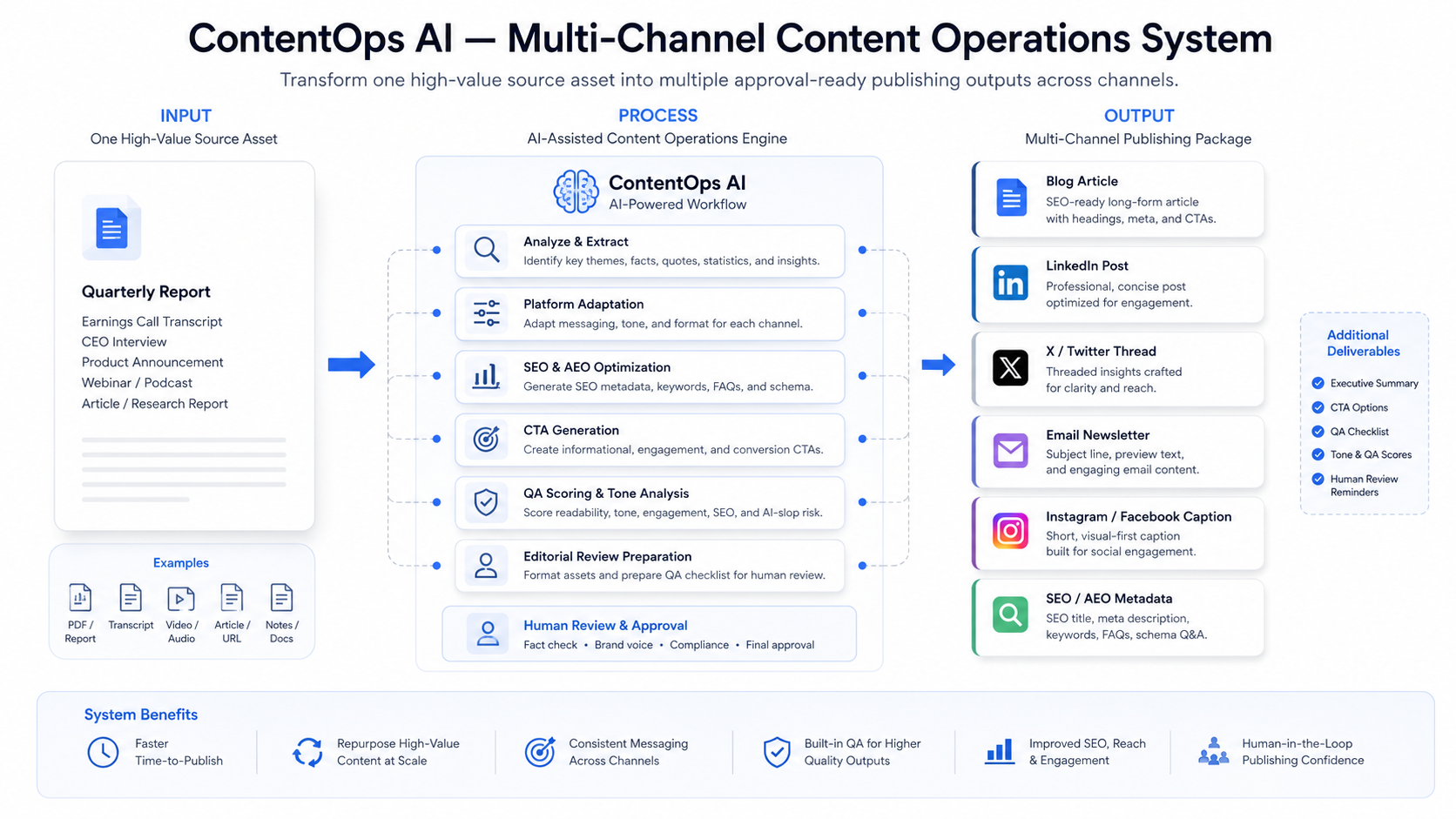
ContentOps AI is an AI-assisted editorial orchestration workflow designed to transform one high-value source asset into structured, platform-specific publishing outputs optimized for readability, engagement, discoverability, and operational publishing workflows.
A reusable content operations system for turning long-form source material into marketing-ready publishing assets with built-in QA, SEO, editorial differentiation, and human review workflows.
Purpose
Many organizations already produce valuable source material: product announcements, webinars, interviews, earnings calls, reports, podcasts, executive commentary, and technical discussions.
The operational problem is that most of this material gets published once and never fully repurposed across distribution channels.
ContentOps AI solves that by transforming one source asset into a structured multi-channel publishing package designed for marketing, engagement, discoverability, and editorial workflows.
Workflow Design
Input:
- Articles
- Reports
- Transcripts
- Earnings calls
- Executive interviews
- Product announcements
- Webinars
- URLs
- Uploaded files
Process:
- Analyze source material
- Extract strategic themes, insights, statistics, and narrative angles
- Identify audience-specific implications
- Generate platform-native publishing assets
- Apply readability, SEO, CTA, and engagement optimization
- Run editorial QA and tone analysis
- Prepare outputs for human review and approval workflows
Output:
- Executive summaries
- Editorial blog articles
- LinkedIn posts
- X/Twitter threads
- Email newsletters
- Instagram/Facebook captions
- SEO / AEO metadata
- CTA suggestions
- QA checklists
- Tone and quality analysis
What Makes This Different From a Regular Prompt?
A standard AI prompt can generate a single asset like “write a LinkedIn post.”
ContentOps AI is designed differently.
Instead of one-off content generation, the system functions as an editorial orchestration layer with reusable workflow logic, platform differentiation, QA controls, and operational publishing structure.
- Predefined input → process → output architecture
- Platform-specific editorial adaptation
- Narrative framing instead of generic summarization
- Audience-aware messaging and pacing
- Editorial differentiation across channels
- Anti-repetition and anti-AI-cadence rules
- SEO / AEO metadata generation
- CTA generation for engagement and conversion
- Human review and approval checkpoints
- QA scoring for readability, clarity, tone, and AI-slop risk
- Support for scalable publishing operations
The value is not simply that AI can generate content.
The value is building a repeatable operational system around AI-assisted editorial production.
Marketing & Distribution Focus
The workflow is designed for marketing and audience engagement workflows, not just informational summaries.
Outputs are optimized to:
- Increase click-through rates
- Improve content reuse
- Support multi-platform publishing
- Encourage engagement and sharing
- Improve discoverability and SEO
- Reduce repetitive editorial work
The system can also support downstream operational workflows including:
- WordPress draft generation
- Social publishing workflows
- Editorial approval pipelines
- Collaborative publishing systems
- Structured export workflows
Example Test Case: Stripe Sessions 2026
For the first workflow test, I used Stripe’s public Sessions 2026 announcement as the source asset.
Source:
Stripe Sessions 2026 Announcement
The workflow transformed the announcement into differentiated multi-channel editorial assets.
Executive Summary
Stripe Sessions 2026 marked a major positioning shift for Stripe.
The company unveiled 288 new products and features centered around one core thesis: AI is becoming a transactional layer of the internet, and payments infrastructure must evolve to support autonomous agents, programmable commerce, and AI-native businesses.
Rather than presenting incremental fintech product expansion, Stripe positioned itself as economic infrastructure for the AI era.
Strategic themes included:
- AI agents becoming economic actors
- Programmable commerce infrastructure
- Stablecoins entering operational financial workflows
- AI-native treasury and money movement systems
- Infrastructure for autonomous transactions
Sample LinkedIn Post
Stripe just told the market where it thinks commerce is heading.
Not toward “AI assistants.”
Toward AI economic actors.
At Sessions 2026, Stripe launched 288 products and features focused on:
- agentic commerce
- AI-native payments
- treasury infrastructure
- programmable money movement
The interesting part wasn’t the product count.
It was the framing.
Stripe increasingly looks less like a payment processor and more like infrastructure for autonomous commerce systems.
Most enterprise AI conversations are still about productivity.
Stripe’s are about economic coordination.
That’s a much bigger market.
Sample X / Twitter Thread
1/ Stripe Sessions 2026 wasn’t really a fintech event.
It was a preview of AI-native commerce infrastructure.
2/ Stripe isn’t talking about AI as productivity software.
It’s talking about AI as an economic actor.
3/ If AI agents begin:
- buying software
- managing subscriptions
- executing workflows
- initiating transactions
…payments infrastructure has to evolve beyond human checkout flows.
4/ Stripe increasingly resembles an operating system for internet commerce rather than a payment processor.
Sample SEO / AEO Metadata
- SEO Title: Stripe Sessions 2026: AI Commerce, Stablecoins, and the Future of Programmable Payments
- Meta Description: Stripe unveiled 288 launches focused on AI-native commerce, programmable financial infrastructure, autonomous transactions, and stablecoin-enabled money movement.
- Keywords: Stripe AI commerce, agentic commerce, AI payments infrastructure, programmable commerce, stablecoin payments, autonomous transactions
Additional Example: Salesforce Enterprise AI Workflow
To test transferability across industries and source types, I also used Salesforce’s Q4 FY2026 earnings call transcript as a source asset.
Source:
Salesforce Q4 FY2026 Earnings Call Transcript
This example focused on enterprise AI infrastructure, autonomous workflows, AI orchestration, and enterprise platform consolidation.
Executive Summary
Salesforce used its Q4 FY2026 earnings call to position itself around the concept of the “agentic enterprise.”
Marc Benioff repeatedly framed AI agents not as productivity tools, but as operational coworkers embedded directly into enterprise workflows.
The company emphasized:
- Agentforce
- Data Cloud
- AI-native workflows
- enterprise orchestration
- AI + CRM integration
The larger strategic goal appears to be consolidating CRM, workflow automation, enterprise data, and AI coordination into one operational platform.
Sample LinkedIn Post
Salesforce’s earnings beat wasn’t the most important part of its Q4 FY2026 call.
The positioning was.
Marc Benioff repeatedly framed Salesforce around the “agentic enterprise”:
humans and AI agents working together across operational workflows.
That’s a major narrative shift.
Salesforce no longer wants to be viewed primarily as a CRM vendor.
It wants to become the orchestration layer for enterprise AI operations.
The broader implication:
AI may reward companies that already control enterprise workflows, customer records, permissions, and operational context.
This felt less like a mature SaaS company defending market share and more like a platform company attempting to define the next enterprise software category.
Sample X / Twitter Thread
1/ Salesforce’s Q4 FY2026 earnings call was less about quarterly numbers and more about redefining the company around AI infrastructure.
2/ The phrase to watch:
“agentic enterprise.”
3/ Salesforce believes enterprises are moving toward:
“humans + agents working together.”
Not AI assistants.
Operational AI systems.
4/ Salesforce is increasingly arguing that AI changes enterprise software architecture itself.
5/ The company no longer wants to be categorized as CRM software.
It wants to become infrastructure for autonomous enterprise operations.
Sample SEO / AEO Metadata
- SEO Title: Salesforce Q4 FY2026 Earnings Analysis: Agentforce, AI Infrastructure, and Enterprise Platform Strategy
- Meta Description: Salesforce beat Q4 FY2026 expectations while positioning Agentforce and enterprise AI orchestration as the company’s next major growth driver.
- Keywords: Salesforce Agentforce, enterprise AI infrastructure, AI orchestration, autonomous enterprise operations, CRM AI platform
Quality Assurance Layer
The workflow includes a built-in editorial QA layer designed to evaluate outputs before publishing.
| Metric | Purpose |
|---|---|
| Readability | Evaluates scannability and ease of reading. |
| Human Tone | Checks for natural editorial cadence and voice. |
| Platform Alignment | Ensures outputs match platform expectations and audience behavior. |
| Engagement Potential | Evaluates click-through and interaction potential. |
| AI-Slop Risk | Flags repetitive or generic AI-generated cadence. |
This turns the workflow into more than a content generator.
It becomes a structured editorial publishing system with built-in quality controls.
Human Review Layer
This workflow is designed for human-in-the-loop publishing.
AI assists with transformation, adaptation, formatting, and editorial acceleration, while humans remain responsible for:
- fact checking
- compliance and legal review
- brand voice validation
- final editorial approval
- publishing decisions
The goal is not to replace editorial judgment.
The goal is to reduce repetitive operational work while improving publishing consistency and speed.
Why It Matters
Most organizations already possess valuable content assets.
The bottleneck is operational execution:
turning source material into consistent, high-quality distribution across multiple channels.
ContentOps AI helps reduce that gap by supporting:
- faster time-to-publish
- editorial consistency
- multi-platform reuse
- better discoverability
- higher content leverage
- leaner publishing operations
Project Takeaway
ContentOps AI demonstrates how AI can function as an operational editorial layer inside modern publishing systems.
The goal is not to create more generic content.
The goal is to build repeatable workflows that transform complex source material into differentiated, platform-native publishing assets.
This project reflects my broader interest in AI-enabled operations, workflow design, editorial systems, and scalable content infrastructure.
Project Access
Try the live GPT workflow here:
Future enhancements may include automated publishing workflows, CMS integrations, collaborative editorial pipelines, structured exports, and approval automation.


You must be logged in to post a comment.